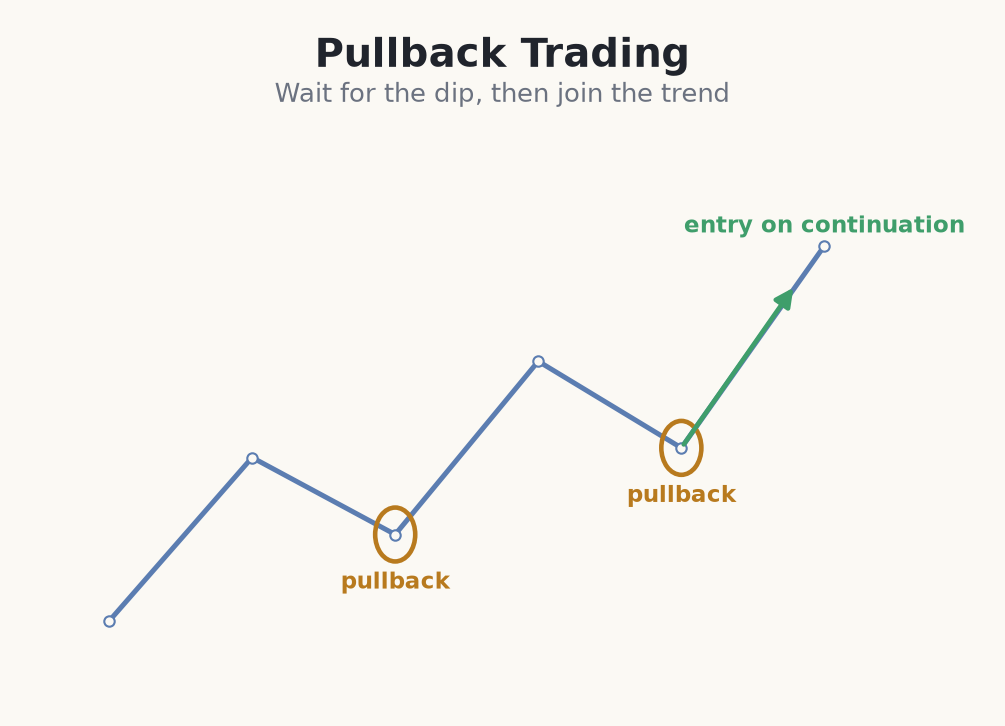
A pullback is a temporary counter-move within a trend — a dip in an uptrend or a bounce in a downtrend. Trading pullbacks is one of the highest-value habits in price action because it lets you join a trend at a better price and with a tighter stop than chasing the move at its extreme. Instead of buying the top of a rally and hoping, you wait for the market to come back to you.
The difference this makes to your numbers is enormous. Chasing an extended move forces your stop far away, which either shrinks your position or widens your risk. Buying a pullback into a logical level puts your stop just beyond that level — often a fraction of the distance — which means the same trade idea can offer two or three times the reward-to-risk. Same direction, same trend, far better entry. That is the entire case for patience.
Where healthy pullbacks stop
Pullbacks don't fall randomly — healthy ones stall at logical areas where buyers are waiting. The most common are a prior support or resistance level, a supply or demand zone, a previous swing point that flipped role, or a moving average many traders watch. When a pullback reaches one of these areas and shows the trend resuming, you have a defined place to enter and, crucially, a defined place to be wrong. A pullback that ignores every level and keeps going is telling you something.
- <strong>Prior swing / support</strong> — the last higher low or a broken level that flipped to support.
- <strong>Supply or demand zone</strong> — an area price reacted strongly from before.
- <strong>Confluence</strong> — the best pullbacks land where two or more of these line up.
- <strong>Only with the trend</strong> — buy dips in an uptrend, sell rallies in a downtrend, never the reverse.
Wait for confirmation — don't catch a falling knife
The biggest error is entering mid-pullback, before price reaches your level or shows any sign of turning. A pullback in progress is still moving against you; buying into it is catching a falling knife. The discipline is to let price come to your level and then wait for a sign the trend is resuming — a strong candle back in the trend direction, a rejection wick, or a small structure forming in your favour. Confirmation costs you a few pips of entry but saves you from the pullbacks that don't stop.
Buying a pullback step by step
- 1EUR/USD is in a clear uptrend. A rally runs from 1.0800 to 1.0900, then starts to pull back. You do not chase near 1.0900.
- 2You mark your level: the prior swing high at 1.0850 that price broke on the way up, which should now flip to support.
- 3Price dips into 1.0850 and prints a strong bullish rejection candle — the sign of the trend resuming. That is your confirmation.
- 4You enter at 1.0860 on the close of that candle, and place your stop just below the pullback's low at 1.0835 — a tight 25-pip risk.
- 5Sizing: on a €1,000 account risking 1% (€10), a 25-pip stop sizes the position to roughly 0.04 lots on EUR/USD — small enough that being wrong costs a planned €10.
- 6Your target is a new higher high beyond 1.0900, say 1.0960 — a 100-pip move for 25 pips of risk, roughly 4:1 reward-to-risk, all because you waited for the dip instead of chasing the rally.
When a pullback is really a reversal
Here is the honest risk: not every pullback resumes. A pullback that breaks structure against you — closing below the last higher low in an uptrend — is no longer a pullback, it is a potential reversal, and your trade idea is invalid. Deep pullbacks that slice through the level without reacting are a warning that the trend is weakening. Respect your stop: the whole point of entering at a level is that the level either holds or it doesn't, and you exit cleanly if it doesn't.
Common mistakes with pullback trading
- Entering mid-pullback. Buying while price is still falling toward your level is catching a knife. Wait for price to reach the level and confirm.
- Trading pullbacks against the trend. A 'pullback' is only valid with the trend. Buying a bounce in a downtrend is just a counter-trend trade in disguise.
- Moving the stop when the level breaks. If price closes through your higher low, the trade is invalid. Sliding the stop lower to 'give it room' just turns a small loss into a big one.
- Ignoring pullback depth. A pullback that blows past the last swing is a red flag the trend may be turning — not a deeper discount to load up on.
- No confirmation. Entering on the level alone, with no sign of the trend resuming, means you're guessing where the dip ends. Let price show you first.
Pullbacks let you buy the dip or sell the rally with the trend — better price, tighter risk, same direction. Let price come to a logical level, wait for confirmation, and treat a break of structure against you as an immediate exit.