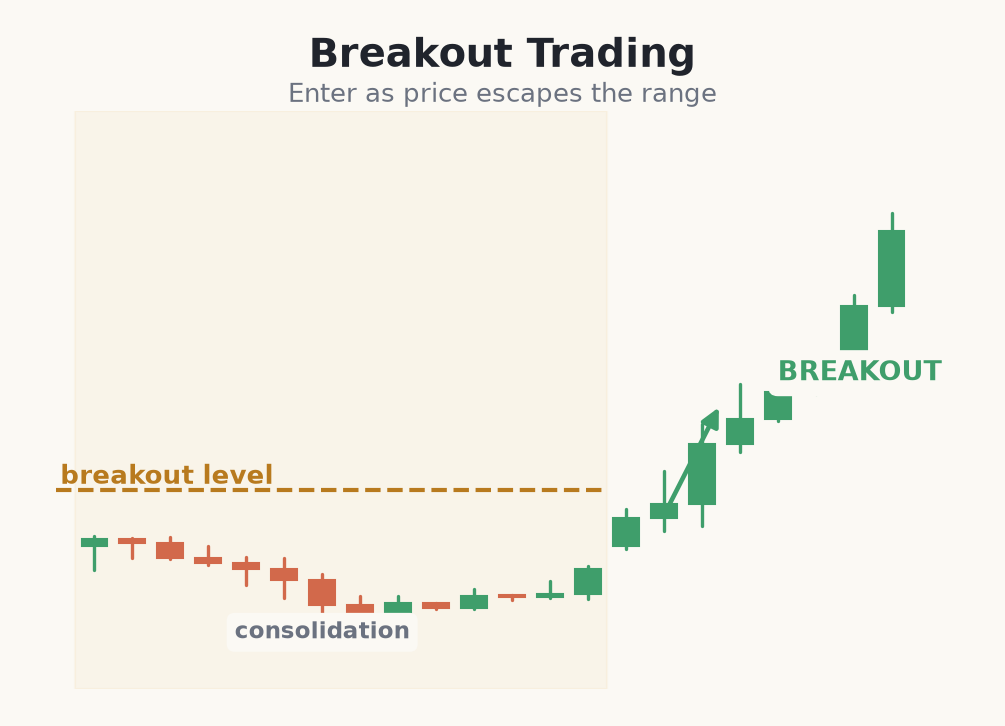
A breakout occurs when price escapes a period of consolidation — a range, triangle or tight band — with force. The logic is simple: while price coils inside a range, orders build up on both sides of it. Once price clears a well-defined level, trapped traders on the wrong side are forced to exit, and momentum traders pile in on the right side. Those two flows together can fuel a fresh directional move.
The key word is force. A breakout is not just price touching the edge of a range — it is price leaving the range and refusing to come back. That distinction is everything, because ranges spend most of their life faking traders out at the edges. A good breakout looks obviously different from those pokes: it is decisive, wide, and closes clear of the level. Learning to tell the two apart is most of the skill in breakout trading.
What a good breakout actually looks like
Quality breakouts share a recognisable fingerprint. They come after a tight consolidation, not a loose sloppy one — the tighter the coil, the more explosive the release. They break with a strong, wide candle that closes clearly beyond the level, not a small indecisive one that just tags it. And context matters: a breakout in the direction of the higher-timeframe trend is far more reliable than one fighting it. A break that stalls the moment it clears the level, or breaks on a tiny candle, is exactly the kind that snaps back and traps you.
- <strong>Tight coil</strong> — a narrow, well-defined range beats a wide messy one.
- <strong>Strong close</strong> — the breakout candle closes clearly beyond the level, not just wicks through it.
- <strong>Trend alignment</strong> — breaks with the higher-timeframe trend fail less often than counter-trend breaks.
- <strong>Volume or momentum</strong> — a genuine break usually arrives with visible expansion, not a quiet drift.
Two honest entries: aggressive and conservative
There are two legitimate ways to enter, and each has a real trade-off. The aggressive entry is on the close of the breakout candle itself — you get in early but risk buying a fake break. The conservative entry is to wait for price to retest the broken level and hold, entering there with tighter risk — you get a better price and confirmation, but some strong breakouts run without ever retesting, and you miss them. Neither is "correct"; pick the one that fits your temperament and be consistent.
Trading a range breakout step by step (EUR/USD)
- 1EUR/USD consolidates for hours in a tight range between a floor of 1.0820 and a ceiling of 1.0850 — a 30-pip band.
- 2A strong bullish candle expands and closes at 1.0858 — clearly above the 1.0850 ceiling, not just a wick. That is your breakout.
- 3Aggressive plan: enter at 1.0858 on the close, stop back inside the range at 1.0838 (a 20-pip risk), because a return inside means the break failed.
- 4Conservative plan: skip the break, wait for a pullback to retest 1.0850, enter on the hold at 1.0852, stop tighter at 1.0838 (a 14-pip risk).
- 5Sizing: on a €1,000 account risking 1% (€10), the 20-pip aggressive stop sizes to about 0.05 lots; the tighter retest stop lets you carry a slightly larger position for the same €10 risk.
- 6Target with a measured move: the range was 30 pips tall, so project 30 pips up from the break for a first target near 1.0880 — a clean, pre-defined objective either way.
Breakouts fail often — that is the whole risk
Be honest with yourself: breakouts fail frequently. The fake breakout is common enough that it has its own module. This is not a reason to avoid them — it is the reason your stop and position size matter more here than almost anywhere else. A logical stop sits back inside the consolidation the breakout left, because a return there proves the break wrong. Size the trade so that being wrong costs you a small, planned amount, and a run of failed breakouts stays survivable.
Common mistakes with breakout trading
- Entering on a wick, not a close. Price tags the level and you jump in, then it closes back inside. Wait for the candle to close beyond the level.
- Chasing an extended break. Buying far above the level after the move has already run puts your stop miles away and your reward-to-risk upside down.
- Trading loose ranges. Breakouts from wide, messy consolidations are far less reliable than those from tight coils. Wait for a clean range.
- Ignoring the higher timeframe. A breakout against a strong daily trend is fighting the current. Prefer breaks aligned with the bigger picture.
- No stop inside the range. Without a defined invalidation back inside the consolidation, a fake breakout can turn into a large, undefined loss.
Trade breakouts that leave tight ranges with force and a strong close. Choose the aggressive break entry or the conservative retest, always place your stop back inside the range, and size small — because breakouts fail often.