A change of character, or CHoCH, is the first time price breaks structure against the prevailing trend. In an uptrend it is the first lower low that breaks a previous higher low; in a downtrend it is the first higher high that breaks a previous lower high. It is the earliest structural hint that the side in control may be losing its grip — the first crack, not the collapse.
Why it matters: think of a healthy uptrend as a staircase of higher highs and higher lows. Every higher low that holds is the buyers saying "we are still defending." A CHoCH is the moment one of those higher lows fails — price closes below a level that, in a healthy trend, should have held. That failure doesn't guarantee a reversal, but it is the first objective evidence that something has changed. Ignoring it is how traders ride a winning trend all the way back to breakeven and beyond.
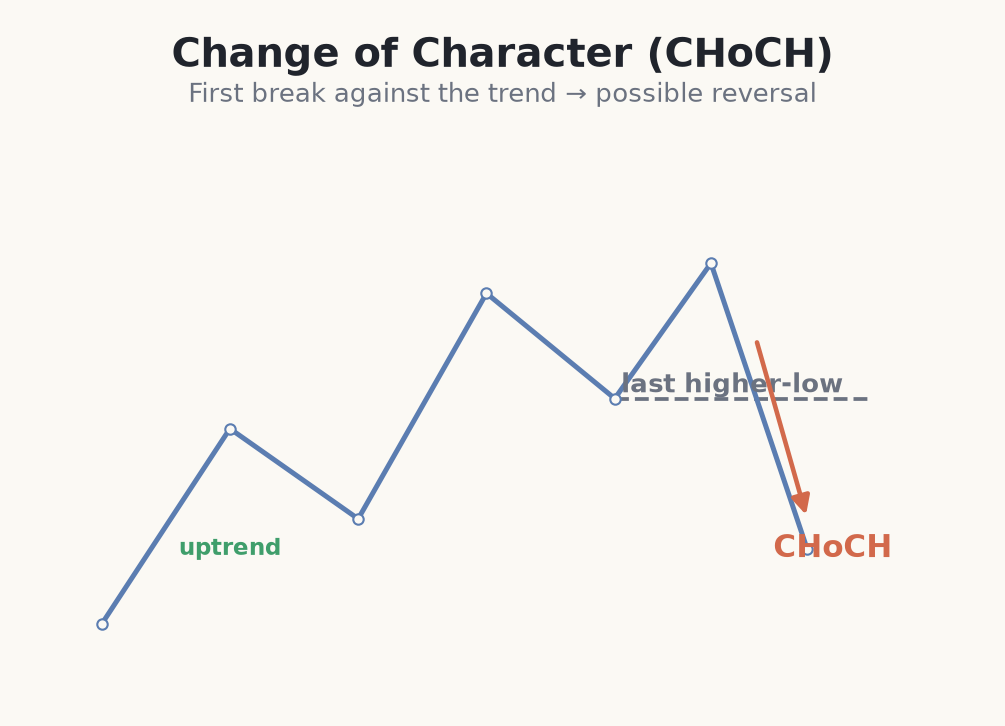
How to spot a CHoCH on a live chart
To spot a CHoCH you first need the trend clearly marked. In an uptrend, identify the last defended higher low — the trough buyers protected on the previous dip. The CHoCH is a candle that closes below that higher low for the first time. In a downtrend, it is the first close above the last lower high. The word 'first' matters: it is the initial break against the trend, not the third or fourth. Demand a body close, not a wick, exactly as you would for a BOS.
CHoCH versus BOS — the direction is everything
A CHoCH and a BOS are the same mechanical event — price breaking a swing point — separated only by direction relative to the trend. A BOS breaks a swing with the trend and confirms it will continue. A CHoCH breaks a swing against the trend and warns it may be ending. If you read them together, you have a simple running commentary on any chart: BOS after BOS means the trend is healthy; the first CHoCH means the character has shifted and you stop looking for continuation entries.
- <strong>In an uptrend</strong> — BOS = new higher high; CHoCH = first lower low breaking a higher low.
- <strong>In a downtrend</strong> — BOS = new lower low; CHoCH = first higher high breaking a lower high.
- <strong>The tell</strong> — a BOS keeps you in the trend; a CHoCH tells you to protect open trades and reassess.
A warning, not a reversal signal
Here is the honest part most guides skip: a CHoCH is a warning, not a guarantee. Trends routinely dip, break a minor higher low, then resume. If you flip short on every first crack, you will get chopped up counter-trend. The correct response to a CHoCH is defensive first: tighten or trail your stop, take partial profit, and stop hunting for trend-continuation entries. Only after a second confirmation — such as a new opposing structure (a lower high followed by a fresh lower low) — should you consider actually trading the reversal.
How to use a CHoCH — protect first, then trade the confirmed turn
Use the CHoCH in two stages. Stage one is defence: the instant the level fails, protect any open trend trade — move to breakeven, trail, or bank partial profit. Stage two is opportunity: if a full opposing structure then forms, you can trade the reversal with your risk defined against the new counter-trend swing. The example below walks through both stages with concrete numbers and proper position sizing.
Acting on a CHoCH step by step (EUR/USD)
- 1You are long EUR/USD in an uptrend. The last defended higher low sits at 1.0850, and your open trade's stop is currently at 1.0820.
- 2Price stalls, makes a lower high, then a bearish candle closes at 1.0838 — below the 1.0850 higher low. That close is your CHoCH.
- 3You do not immediately flip short. First you protect: you move your stop up to 1.0845 to lock the long near breakeven, or take partial profit.
- 4You wait for confirmation. Price bounces to 1.0872 (a lower high) then breaks down again, closing below 1.0838 — now a lower high and a lower low: a new bearish structure.
- 5Only now do you consider a short: entry on the retest at 1.0860, stop above the 1.0872 lower high at 1.0890 — a 30-pip risk. On a €1,000 account risking 1% (€10), that sizes to about 0.03 lots.
- 6Target the prior demand near 1.0770 (90 pips) — roughly 3:1 reward-to-risk: a reversal the CHoCH warned you about, but the second break confirmed.
Common mistakes with change of character
- Treating a CHoCH as a confirmed reversal. It is the first crack, not the break. Flipping instantly on every CHoCH bleeds you counter-trend. Wait for a second, opposing structure.
- Ignoring it entirely. The opposite error — riding a winning trend straight through the first CHoCH and giving back all the profit. Use it at least to protect the trade.
- Counting a wick as the break. As with a BOS, demand a candle close beyond the swing, not a wick that pierces and snaps back.
- Reading it on too low a timeframe. A 1-minute CHoCH inside a strong daily uptrend is noise. Anchor the trend on a higher timeframe and read the CHoCH there.
- Forgetting which swing matters. The CHoCH is the break of the last defended higher low (or lower high), not any old level. Mark the swing that actually held the trend together.
A change of character is the first structural break against the trend — an early warning to protect open trades and stop chasing continuation, not proof of a reversal. Wait for a second opposing structure before trading the turn.