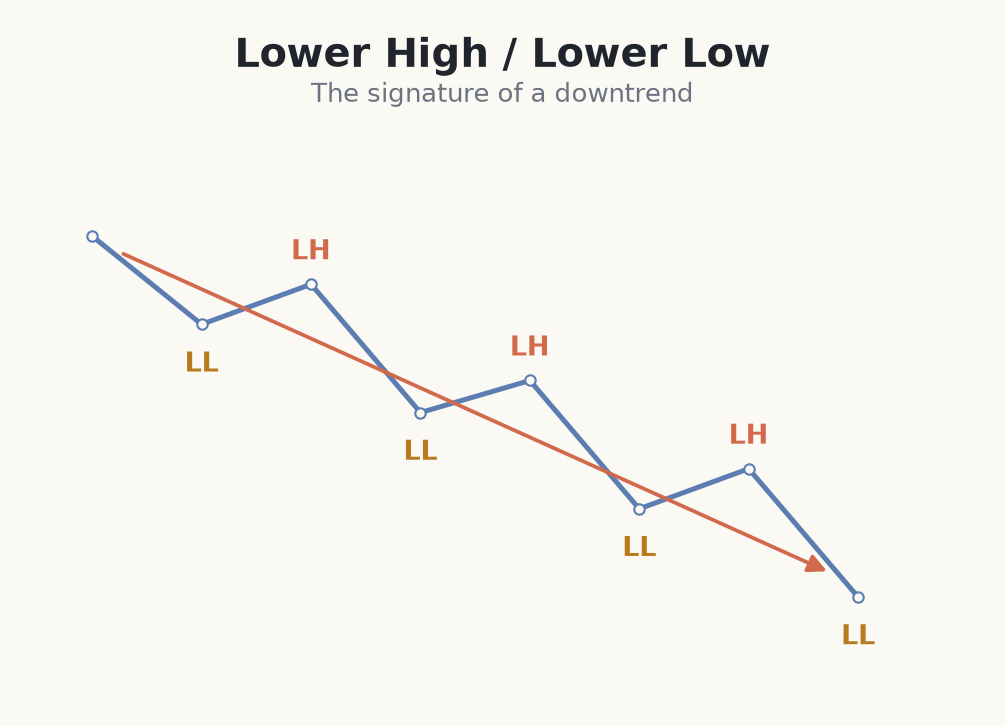
A downtrend is the mirror image of an uptrend: lower highs (LH) and lower lows (LL). Each rally fails below the previous peak and each decline breaks the previous trough. Sellers are in control, and every bounce is being sold into rather than bought. As long as this descending staircase holds, the path of least resistance is down — and the moment price makes a higher high, that control is in doubt.
Why the lower high matters most
In a downtrend the lower high is the key tell — and the tradable one. It shows that sellers stepped in early, capping the bounce before it could reach the previous high. That eagerness to sell is the weakness you want to bet on. A rally that stalls into a fresh lower high gives you a favourable short entry with a tight, clearly defined risk point right above it.
How to confirm the sequence
Read the swings left to right and check two boxes: is each new low below the last low, and is each bounce topping below the last high? Two yeses and the downtrend is confirmed. Require a candle close below the prior low rather than a wick — a wick that pokes lower and closes back up is often a trap, not a real lower low.
How to trade it, step by step
The cleaner play is not shorting the fresh low in a panic — it is selling the bounce into a fresh lower high once sellers reappear. This gives you a tight stop above the swing high and a large potential move if the decline continues.
Shorting a bounce into a lower high
- 1On the 1-hour US30 chart, price prints a lower low at 38,000 after a prior swing low of 38,300 — the downtrend is confirmed.
- 2Price bounces and stalls at 38,250, comfortably below the previous lower high of 38,500. This is your fresh lower high forming.
- 3You wait for a bearish confirmation candle (a strong red close off 38,250) instead of shorting into strength, and enter at 38,210.
- 4Your stop goes just above the lower high at 38,300 — a close above it means the LH failed and the thesis is dead. Risk = 90 points.
- 5You target the measured continuation toward 37,750 (a new lower low), about 460 points away — roughly a 5:1 reward-to-risk before costs.
- 6Your plan is set before entry: sell 38,210, stop 38,300, target 37,750, and one rule — a close above 38,300 and you're out.
Common beginner mistakes with LH/LL
- Shorting the fresh low instead of the high. Selling as price makes a new low puts your stop far away and your entry into potential support. Sell the bounce into the lower high.
- Calling a wick a lower low. A wick below the last trough that closes back above is not a lower low — it may be a bear trap. Wait for the close.
- Ignoring a broken lower high. Once price closes firmly above the last LH, the downtrend is in doubt — stop shorting bounces until structure repairs.
- Forgetting that shorting has its own risks. Falling markets can snap back violently on short squeezes. Size carefully and never move a stop wider 'to give it room'.
- Shorting with no confirmation. A bounce can keep rising into a full reversal. Waiting for sellers to actually resume costs a little entry but avoids fighting a real trend change.
As long as price prints lower highs and lower lows, the path of least resistance is down — sell the bounce into a fresh lower high and put your stop just above it.