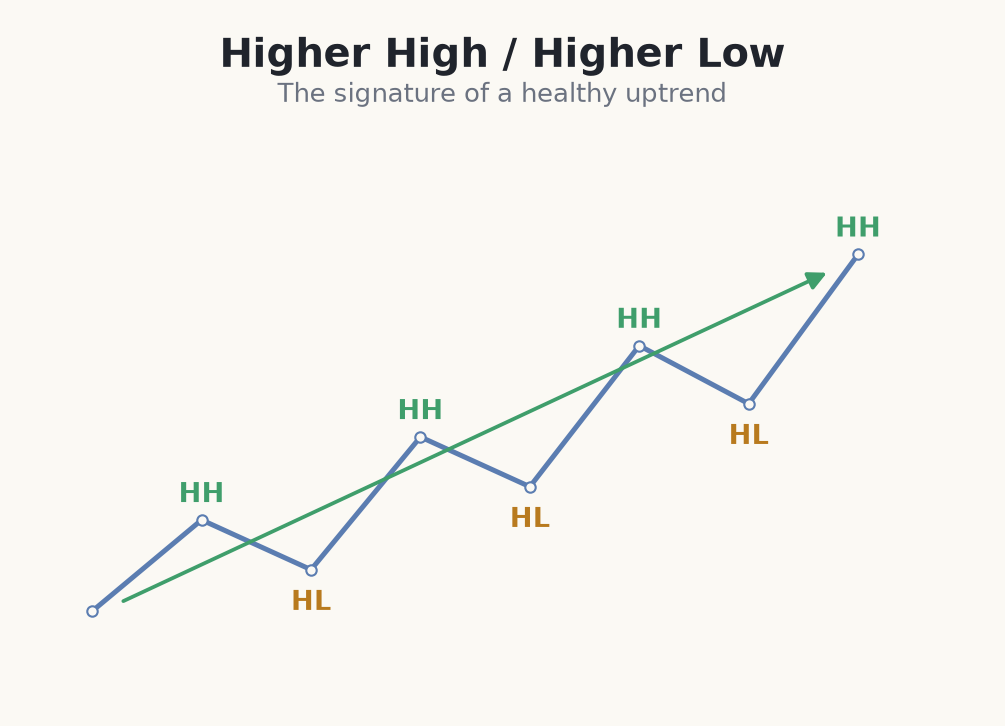
An uptrend is defined by two things repeating: higher highs (HH) and higher lows (HL). Each rally pushes above the previous peak, and each dip stops above the previous trough. As long as this staircase holds, buyers are in control and the path of least resistance is up. The moment price fails to make a higher high, or breaks a higher low, that control is in question.
Why the higher low matters most
Of the two, the higher low is the more important — and the more tradable. It shows that buyers stepped in early, unwilling to let price fall as far as it did last time. That impatience is exactly the strength you want to bet on. When a fresh higher low forms and holds, it often gives the cleanest, lowest-risk entry into a continuing uptrend, because your stop can sit just below it where the structure would break.
How to confirm the sequence
Read the swings left to right and check two boxes: is each new high above the last high, and is each new low above the last low? Two yeses in a row and you have a confirmed uptrend. A useful filter is to require a candle close above the prior high, not just a wick poke — wicks lie, closes commit.
How to trade it, step by step
The highest-probability play is not chasing the breakout — it is buying the pullback into a fresh higher low once buyers show up again. That gives you a tight stop and a big potential move if the trend continues.
Buying a pullback to a higher low
- 1On the 1-hour chart, gold prints a higher high at 2050 after a prior swing high of 2030 — the uptrend is confirmed.
- 2Price pulls back and stalls at 2028, comfortably above the previous higher low of 2010. This is your fresh higher low forming.
- 3You wait for a bullish confirmation candle (a strong green close off 2028) rather than catching the falling knife, and enter at 2032.
- 4Your stop goes just below the higher low at 2024 — if that breaks, the HL failed and the trade thesis is dead. Risk = 8 points.
- 5You target the measured continuation toward 2075 (a new higher high), about 43 points away — roughly a 5:1 reward-to-risk before costs.
- 6Your whole plan exists before entry: buy 2032, stop 2024, target 2075, and one rule — a close below 2024 and you're out.
Common beginner mistakes with HH/HL
- Chasing the high instead of the low. Buying as price prints a new high gives you a far-away stop and terrible risk. Buy the higher low, not the breakout candle.
- Calling a wick a higher high. A wick above the last peak that closes back below is not a higher high. Wait for the close.
- Ignoring a broken higher low. Once price closes firmly below the last HL, the uptrend is in doubt — stop buying dips until structure repairs.
- Assuming trends are forever. Every HH/HL sequence eventually ends. Take partial profit or trail your stop; don't marry the trade.
- Buying with no confirmation. A pullback can keep falling. Waiting for buyers to actually show up costs a few pips of entry but saves you from catching knives.
As long as price prints higher highs and higher lows, the path of least resistance is up — buy the pullback into a fresh higher low and put your stop just below it.