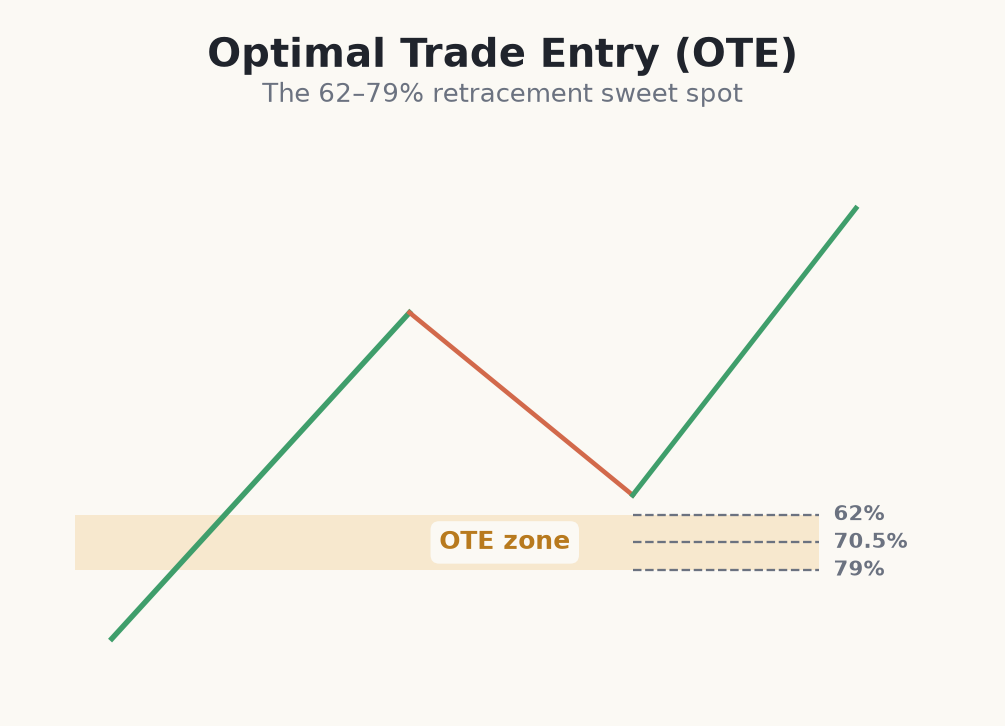
What it is: Optimal Trade Entry, or OTE, is a concept popularised by smart-money traders that focuses on entering trades in the deep retracement zone. Rather than buying a shallow dip, OTE waits for price to pull back into the 62%–79% area, where the reward-to-risk on a trend continuation is at its best.
Why enter deep?
The logic is arithmetic. Entering near the 78.6% level puts your stop only a little below the origin swing, while your target back toward the extreme and beyond is far away. That geometry produces a high reward-to-risk ratio — often 3:1 or better — which means you can be wrong more often than right and still come out ahead.
The trade-off
The catch is that deep retracements have a higher failure rate: by the time price reaches 79%, the trend is under real pressure and may be reversing. OTE therefore demands confirmation — a rejection, a lower-timeframe structure shift — and a firm stop just beyond the origin swing, because if that breaks the whole idea is void.
- OTE zone: roughly 62% to 79% retracement of the leg.
- Entry near the deep end maximises reward-to-risk.
- Stop sits just beyond the swing that started the move.
- Deeper entries mean better R:R but a higher chance of failure.
The R:R and win-rate trade-off in numbers
Why it matters: a shallow 38.2% entry has a higher chance of holding but poor geometry — small target, wide-ish stop. A deep 78.6% entry flips that: excellent geometry, lower hit-rate. If your OTE trades pay 3:1, you only need to win about 1 in 3 to break even. That is the whole point — OTE trades survival maths, not being right often. But do not romanticise it: the deeper you go, the more the trend is under strain, so a stop beyond the origin swing is non-negotiable.
OTE long in the 62%–79% zone — GBP/USD (€1,000)
- 1GBP/USD trends up on the 15-minute. The latest impulse runs from swing low 1.2700 to swing high 1.2800 (100 pips).
- 2You draw the retracement and mark the OTE band: 62% = 1.2738 to 79% = 1.2721. The 70.5% midpoint sits at 1.2730 — your ideal fill.
- 3Price pushes deep into the band and prints a bullish rejection wick at 1.2726, plus a lower-timeframe higher low. Confirmation. Entry 1.2730.
- 4Stop just below the origin swing at 1.2695 = 35 pips. Risk 1% of €1,000 = €10, size ≈ 0.028 lots (~€0.28/pip).
- 5Target the prior high 1.2800 and the 127.2% extension at 1.2827 (~97 pips) — about 2.8:1. Deep entry = tight stop = strong geometry, but if 1.2695 breaks the trend read is void and you are out.
Common OTE mistakes
- Buying the OTE with no confirmation. The deep zone fails often. A blind limit at 70% catches every pullback that keeps falling. Wait for rejection or a structure shift.
- Widening the stop below the origin swing. The whole R:R advantage comes from a tight stop just past the origin. Widen it and you destroy the only reason to enter deep.
- Using OTE against the trend. OTE is a continuation tool. In a downtrend, the 'deep pullback' up is a shorting zone, not a place to buy the reversal.
- Over-sizing because R:R looks great. Better geometry does not mean bet bigger. Keep fixed 1% risk — the higher failure rate punishes over-leverage fast.
- Treating 3:1 as a promise. The reward-to-risk is potential, not guaranteed. Many OTE trades stop out; the edge only shows across many trades with disciplined risk.
OTE trades the deep 62%–79% zone for maximum reward-to-risk — great geometry, but only with confirmation and a stop beyond the origin swing.