What it is: Smart-money concepts (SMC) describe how large players leave footprints on the chart — order blocks, fair value gaps and liquidity pools. Fibonacci pairs naturally with SMC because both try to answer the same question: where is price likely to react on its way back into a trend?
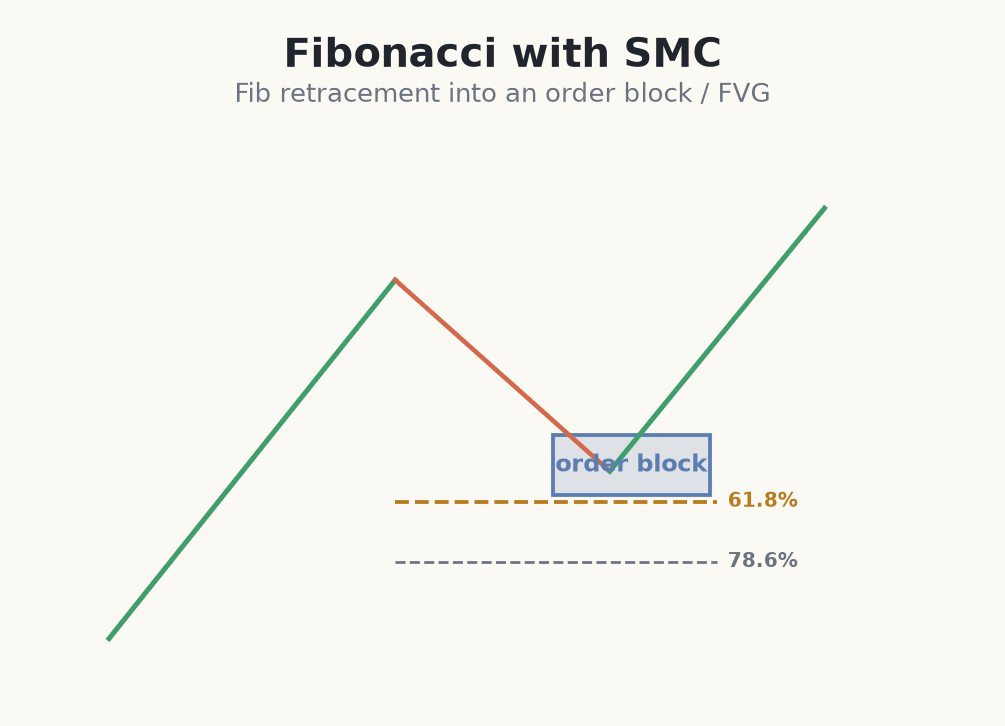
Retracing into an order block
An order block is the last opposing candle before a strong impulsive move — a zone where institutional orders are thought to rest. When a Fibonacci retracement pulls price back into an order block, and especially when that block sits near the 61.8%–78.6% area, you have a smart-money zone and a Fibonacci zone pointing to the same price.
Fair value gaps — imbalances left by fast candles — often sit inside the same retracement band and act as magnets for price. Aligning a Fibonacci level with a fair value gap or a swept liquidity level gives a precise, evidence-based entry rather than a round guess.
- Mark the order block or fair value gap from the impulsive leg.
- Overlay the retracement; look for the block inside the 61.8%–78.6% zone.
- Enter on a reaction inside the block, stop beyond it.
- SMC and Fibonacci are both interpretive — demand confirmation.
Why the two frameworks agree
Why it works: both tools are really describing the same thing — where resting orders sit. An order block marks the candle that launched the move (unfilled orders left behind); the deep Fibonacci band marks where the crowd expects the pullback to end. When they coincide, you have institutional footprints and retail expectation at one price. That said, SMC labelling is highly subjective: two traders draw different order blocks on the same chart, so treat the overlap as a lead to confirm, not proof.
Fibonacci-into-order-block long on EUR/USD (€1,000)
- 1EUR/USD prints a strong bullish impulse from 1.0900 to 1.1000 (100 pips). The last bearish candle before the impulse — the bullish order block — sits at 1.0925–1.0935.
- 2Draw the retracement of the 1.0900→1.1000 leg: 61.8% = 1.0938, 78.6% = 1.0921. The order block (1.0925–1.0935) sits squarely in the 61.8%–78.6% band.
- 3There is also a small fair value gap at 1.0930 inside the block. Price retraces in and prints a bullish engulfing at 1.0932 — reaction inside the block.
- 4Entry 1.0936, stop below the block at 1.0916 = 20 pips. Risk 1% of €1,000 = €10, size ≈ 0.050 lots (~€0.50/pip).
- 5Target the prior high at 1.1000 (~64 pips) for about 3.2:1. The tight stop comes from the precise block; a break below 1.0916 means the smart-money read was wrong and you are out.
Common Fibonacci-plus-SMC mistakes
- Drawing order blocks to fit the Fibonacci. SMC is subjective — if you nudge the block until it hits 61.8%, you are manufacturing confluence, not finding it.
- Treating SMC as objective truth. Order blocks and FVGs are interpretations, not facts. Two traders mark them differently; demand a reaction, not faith.
- Ignoring the trend. A bullish order block in a broken-down market is just a level price falls through. SMC entries still need trend alignment.
- Stops inside the block. A stop within the order block gets swept by the very liquidity grab the block represents. Place it just beyond the block.
- Chasing every FVG. Not every imbalance fills or reacts. Wait for the confluence with the deep Fibonacci band and a confirming candle.
When a Fibonacci level overlaps an order block or fair value gap, you have both smart-money and Fibonacci logic pointing to one entry.