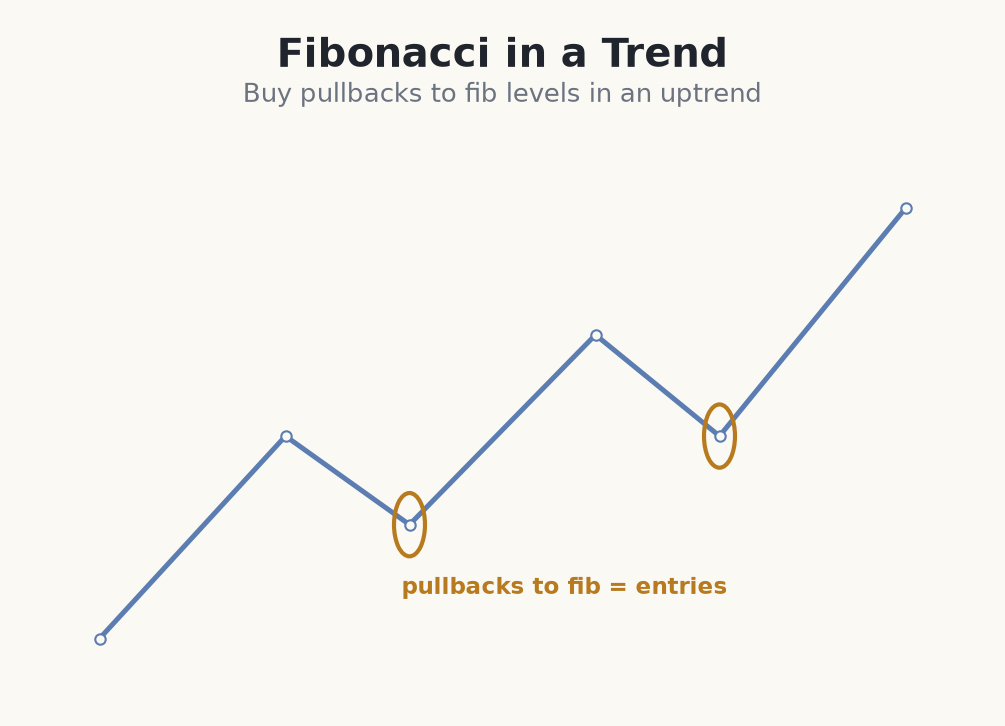
What it is: Fibonacci works best when it is used with the trend, not against it. In a healthy uptrend, each pullback into a Fibonacci level is a chance to join the move at a discount; in a downtrend, each bounce into a level is a chance to sell into strength. Trend direction decides which levels you care about.
Trading with the trend
In an uptrend, wait for a pullback into the 38.2%–61.8% band and look for the trend to resume before entering long. A logical stop sits just below the swing low that anchored the retracement, because a break there means the pullback has become a reversal. In a downtrend, mirror everything: sell rallies into the band with a stop above the swing high.
Why trend-aligned Fibonacci has the edge
Why it works: a trend is the market's path of least resistance — more buyers than sellers in an uptrend. Buying a pullback means entering with that flow at a temporary discount, while the counter-move traders who sold the dip become fuel when they cover. Fading the trend at a Fibonacci level does the opposite: you fight the dominant flow and hope the level holds. Same level, very different odds. Structure defines the trend; Fibonacci only fine-tunes the entry inside it.
Shallow retracements to 23.6%–38.2% signal a strong trend that offers little discount but high momentum. Deeper pulls to 61.8%–78.6% give better prices but demand more caution, because the deeper the retrace, the greater the risk the trend is done. Match your entry style to how far price has pulled back.
Buying a trend pullback on EUR/USD (€1,000 account)
- 1EUR/USD is in a clear uptrend on the 1-hour: higher highs, higher lows. The latest impulse runs from swing low 1.0850 to swing high 1.0950 (100 pips).
- 2You draw the retracement. Levels: 38.2% = 1.0912, 50% = 1.0900, 61.8% = 1.0888. You only look for longs — the trend is up.
- 3Price pulls into the 50% (1.0900) and holds, printing a higher low and a bullish close. Trend-aligned confirmation. Entry 1.0905.
- 4Stop below the 61.8% and the prior swing low at 1.0845 = 60 pips. Risk 1% of €1,000 = €10, size ≈ 0.016 lots (~€0.16/pip).
- 5Target a new high beyond 1.0950, projecting the 127.2% extension at 1.0977 (~72 pips, ~1.2:1) and 161.8% at 1.1012 (~107 pips, ~1.8:1). You joined the trend at a discount, not fought it.
Common trend-Fibonacci mistakes
- Fading the trend at a level. Shorting a 38.2% pullback in a strong uptrend because 'it's overbought' fights the dominant flow. Trade with the trend, not against it.
- Calling a range a trend. Fibonacci pullbacks only work when there is a real trend. In a sideways range, 'dips' and 'rallies' are just noise between the edges.
- Buying the deep 78.6% blindly. The deeper the retrace, the higher the chance the trend is already done. Deep entries need extra confirmation, not less.
- Entering with no reaction. Price touching 50% is not a signal. Wait for a higher low or a bullish close before committing.
- Moving the stop below structure to avoid the shake-out. If price closes below the swing low, the pullback became a reversal — respect the invalidation instead of widening it.
Use Fibonacci to buy dips in uptrends and sell rallies in downtrends — trade the pullback, not the reversal.
The biggest edge here is that you are aligning with structure. Fibonacci does not tell you the trend — market structure does. Read the higher highs and higher lows first, then let Fibonacci fine-tune your entry inside that trend.