What it is: If retracements tell you where a pullback might end, extensions tell you where the next leg might go. Extensions project levels beyond 100% of a move, giving objective targets for taking profit once the trend resumes. They turn a vague 'ride the trend' plan into specific price zones you decide on before you enter.
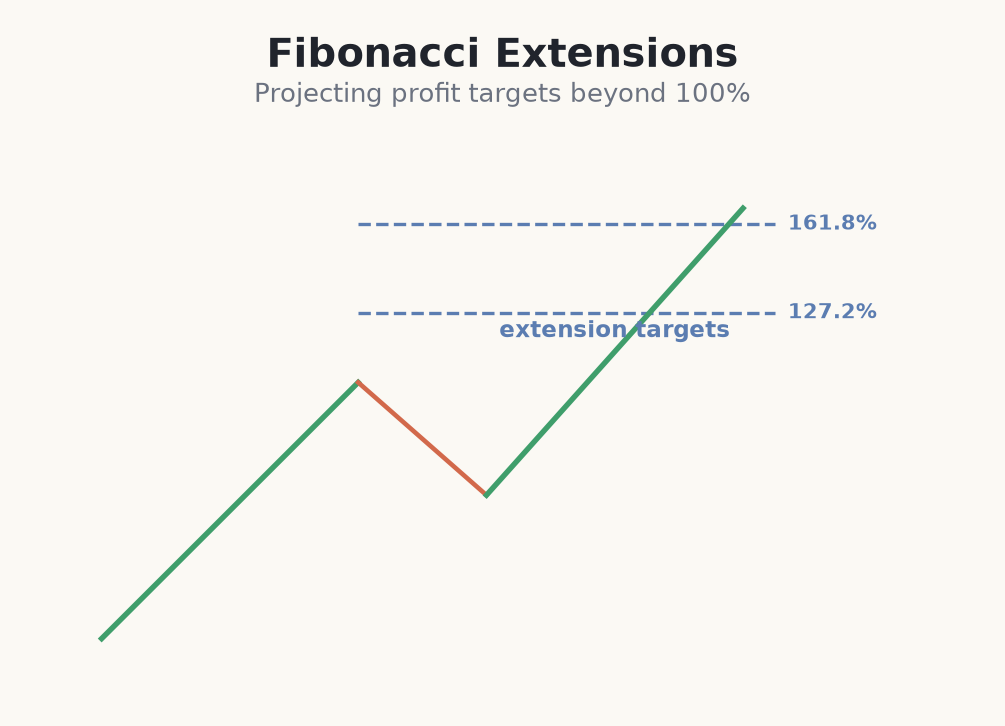
The key extension ratios
The two most watched extensions are 127.2% (the square root of 1.618) and 161.8% (the golden ratio itself). Beyond those, 200% and 261.8% are used for very extended moves. These levels are drawn from the same swing structure used for retracements, so a single set of anchors can give you both entry and target.
Why extensions beat a random target
Why it works: most traders lose winners by having no exit plan — they either take profit too early out of fear, or hold too long out of greed. An extension replaces emotion with a pre-defined price. It works for the same crowd reason as retracements: the 161.8% is where large numbers of traders take profit, so supply/demand often clusters there and the move genuinely stalls. It is not that price must reach 161.8% — it is that if it gets there, that is a statistically sensible place to bank.
How to use extensions
A common workflow is to enter on a retracement, then set partial targets at the 127.2% and 161.8% extensions of the prior impulse. Because trends often stall or reverse at these projections, they are natural places to bank profit, tighten a stop, or scale out rather than gambling on an open-ended move.
- 127.2% — the first, most conservative extension target.
- 161.8% — the classic 'measured move' target.
- 200% / 261.8% — stretch targets for powerful trends.
- Extensions are targets, not signals — confirm with structure.
Entering on a retrace, exiting on extensions — EUR/USD (€1,000)
- 1EUR/USD runs from a swing low 1.0700 to a high 1.0800 (100-pip impulse), then pulls back. You use the retracement 61.8% at 1.0738 to enter long at 1.0742 on a rejection candle.
- 2Stop below the swing low at 1.0692 = 50 pips. Risk 1% of €1,000 = €10, so size ≈ 0.020 lots (~€0.20/pip).
- 3Now project extensions of the original 1.0700→1.0800 leg: 127.2% = 1.0827, 161.8% = 1.0862, 200% = 1.0900.
- 4Scale out: take half at 127.2% (1.0827, ~85 pips, ~1.7:1) and move the stop to break-even. Let the rest run toward 161.8% (1.0862, ~120 pips, ~2.4:1).
- 5If price stalls and rejects 161.8%, you close the remainder there. The plan — entry 1.0742, stop 1.0692, targets 1.0827 / 1.0862 — was fully written before the trade, so no mid-trade panic decides your exit.
Common mistakes projecting targets
- Treating an extension as a certainty. Price reaching 161.8% is a probability, not a promise. Trends can die at 127.2% or blow past 261.8% — extensions guide exits, they do not command price.
- All-or-nothing targeting. Holding the full position for one distant level often turns winners into losers. Scaling out at 127.2% then 161.8% locks in profit and reduces regret.
- Projecting off the wrong leg. Extensions must be measured from the same clean impulse you drew the retracement on. Anchor to noise and your targets land in empty space.
- Never moving the stop. Once the first extension pays, trailing to break-even removes risk. Sitting with the original stop after banking half is giving profit back.
- Chasing the 261.8% every time. Stretch targets only make sense in genuinely powerful trends; in an average move they rarely fill and you round-trip your gains.
Extensions project realistic targets beyond 100% — 127.2% and 161.8% are the standard levels for scaling out of a winning trend.