What it is: The Butterfly is an extension pattern: unlike the Gartley, its completion point D pushes beyond X, projecting to a new extreme. It aims to catch reversals at the exhausted end of a move rather than inside a pullback, which makes it more aggressive.
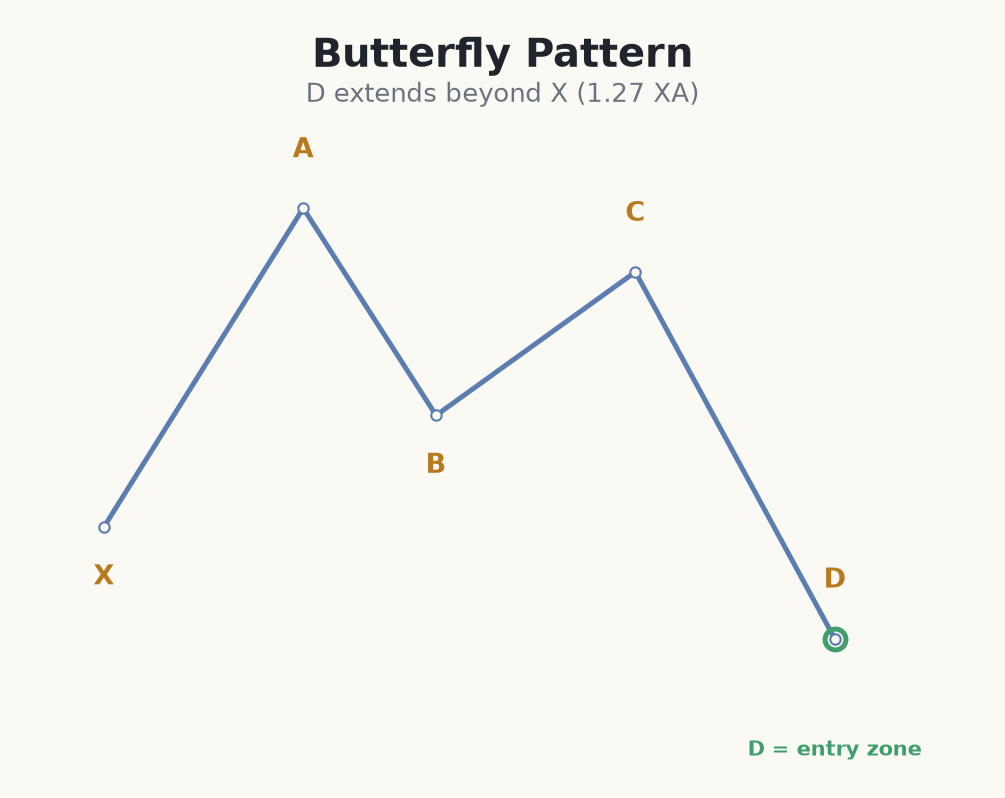
Defining ratios
- B retraces 78.6% of the XA leg.
- BC retraces 38.2% to 88.6% of AB.
- CD extends 161.8% to 224% of BC.
- D projects to 127.2% to 161.8% of XA — beyond X.
The defining feature is the 78.6% B-point combined with a D that reaches the 127.2%–161.8% extension of XA. Because D sits past X, the Butterfly targets a fresh high or low where the prior move is stretched thin and prone to snapping back.
Trading the Butterfly
How to use it: enter at D as price reaches the extension zone and shows rejection, expecting a reversal. Because D is already an extreme, the stop sits just beyond D — a short distance past the 161.8% projection — since there is no X to hide behind on the far side. Confirmation matters even more here, as catching an extended reversal is inherently harder.
Why it's more aggressive: where the Gartley buys a contained pullback, the Butterfly fades a fresh extreme — price is making a new high or low when you take the counter-trade. That is genuinely harder: momentum is against you at the moment of entry, so the false-completion rate is higher. The pay-off is a tight stop just past D and a large target back toward the origin, but only confirmation keeps you out of the moves that keep extending.
Bearish Butterfly short on EUR/USD (€1,000)
- 1EUR/USD prints a bearish Butterfly: X = 1.0800, A = 1.0700 (XA = 100 pips), B = 1.0779 (78.6% of XA), C = 1.0730.
- 2D projects to 127.2% of XA = 1.0827 (beyond X at 1.0800) — a fresh high. The PRZ is 1.0824–1.0832.
- 3Price spikes to 1.0829 and prints a bearish rejection wick — confirmation at D. Entry 1.0824.
- 4Stop just beyond D at 1.0844 = 20 pips. Risk 1% of €1,000 = €10, size ≈ 0.050 lots (~€0.50/pip).
- 5Target C at 1.0730 (~94 pips, ~4.7:1) and A at 1.0700. The tight stop past D gives strong geometry — but you are fading a new high, so a close above 1.0844 means the move kept extending and you take the small loss.
Common Butterfly mistakes
- Confusing it with a Gartley. The Butterfly needs B at 78.6% and D beyond X. If D stays inside XA, it is not a Butterfly — check the ratios before labelling.
- Putting the stop beyond X. There is no X on the far side of D here. The stop goes just past the 161.8% extension, or your risk balloons.
- Fading with no rejection. You are shorting a fresh high — the riskiest entry there is. No rejection candle, no trade.
- Ignoring strong momentum through D. If price closes cleanly beyond the extension, the move is not exhausted. Do not add against it.
- Over-sizing on the great R:R. The tight stop tempts bigger bets, but extended reversals fail often. Keep fixed 1% risk.
The Butterfly reverses beyond X at the 127.2%–161.8% extension of XA — enter at D on rejection, stop just past the extension.