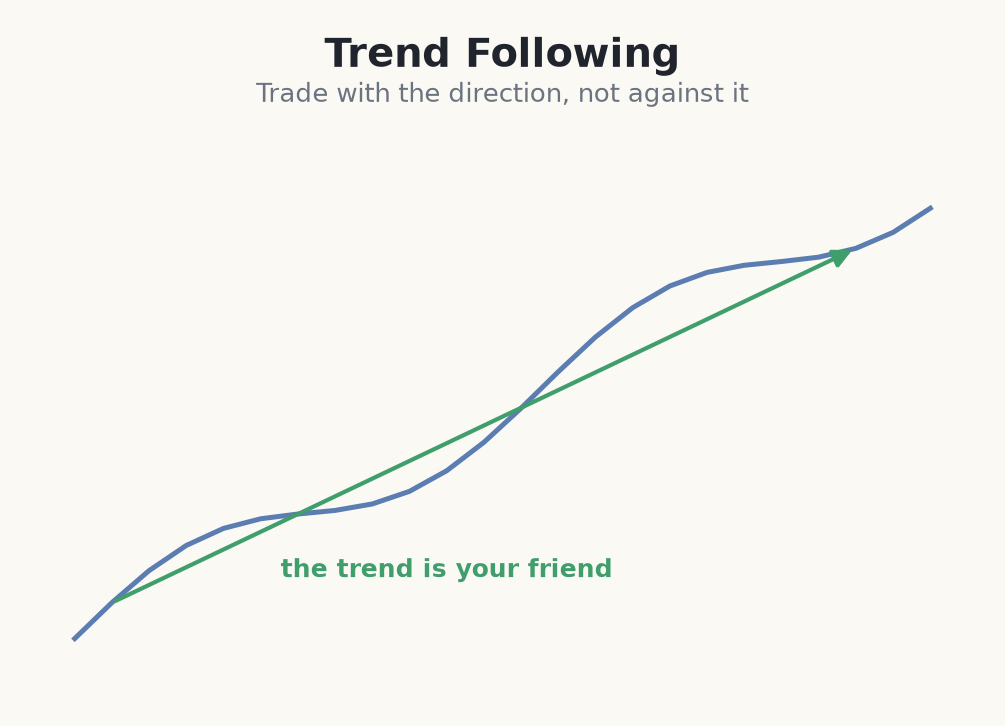
Trend following is the practice of trading in the direction of the trend rather than trying to predict tops and bottoms. The core belief is simple: markets that are moving up or down tend to keep going for longer than most people expect, so it pays to join the move rather than fight it. You are not trying to be clever or early — you are trying to be aligned with the money that is already flowing one way.
Why follow the trend?
A trend represents the path of least resistance. When buyers are consistently in control, buying pullbacks tends to work better than shorting; when sellers dominate, the reverse is true. The why is behavioural: a rising market attracts fresh buyers, forces trapped sellers to cover, and feeds on its own momentum until something breaks it. Fighting that flow means betting against every one of those participants at once.
The trade-off is emotional. Trend followers accept many small losses in exchange for occasionally catching a large, sustained move that pays for all of them and more. Most of your trades may be scratches or small losers; a minority of big winners carries the whole account. If you cannot stomach being wrong often while staying disciplined, trend following will feel unbearable long before it works.
This course leans on technical indicators — moving averages, RSI, MACD, Bollinger Bands and others. Every one of these is math applied to price, which means they lag behind the market. They summarise what price has already done; they never see the future. Used well, they are a filter and a discipline aid. Used badly — as a crystal ball — they are a fast way to lose money with false confidence.
How to think about the whole approach
- Indicators describe <strong>trend, momentum and volatility</strong> from past price.
- Because they are derived from price, all indicators <strong>lag</strong> to some degree.
- They shine in trends and <strong>struggle in choppy</strong>, sideways markets.
- No indicator is a signal to blindly follow — context and risk still rule.
Turning a trend read into a sized trade
- 1On the 4-hour EUR/USD chart price is making higher highs and higher lows and sits above a rising average — you only look for buys.
- 2Price pulls back and stalls near the last higher low at 1.0850, then prints a strong green close showing buyers returning. You enter long at 1.0870.
- 3Your stop goes just below the higher low at 1.0835 — a close there means the uptrend read was wrong. Risk = 35 pips.
- 4Account is €2,000 and you risk 1% = €20. With a 35-pip stop you size so 35 pips against you costs ~€20 — about 0.05 lots on EUR/USD.
- 5You target the measured continuation near 1.0990, ~120 pips away — roughly 3.4:1 reward-to-risk. The whole plan exists before you click.
Common beginner mistakes with trend following
- Picking tops and bottoms. Trying to call the exact turn is the opposite of trend following. Join the move you can already see, don't guess the one you hope for.
- Treating indicators as signals. A crossover or an oversold reading is context, not a command. Blindly acting on one line is how beginners bleed out in ranges.
- Bailing on the small losers. Trend following pays through a few big winners funded by many small losses — cutting winners early to 'lock it in' quietly destroys the whole edge.
- Fighting the higher timeframe. A one-hour bounce inside a daily downtrend is still a short setup. Let the bigger picture set your bias before any indicator.
- Skipping risk management because 'the trend is obvious'. Obvious trends reverse too. No amount of trend clarity removes the need for a stop and a sensible size.
Trend following means trading with the market's direction — indicators help you read that direction, but they lag price and never guarantee it.
Quick check
A one-hour chart is bouncing up, but the daily chart is in a clear downtrend. What's the trend-following bias?
Throughout this course we build up in layers: first read the trend, then add moving averages, momentum tools and volatility bands, and finally combine them into one disciplined plan. Because no tool is perfect, risk management is the thread that runs through every module — the same defined-stop discipline you just saw applies to every setup ahead.