The 5-minute chart is a more forgiving home for most scalpers. Candles carry more information, spread is a smaller fraction of a typical target, and there is a little more time to think. Many traders who fail on the 1-minute do far better simply by slowing down to the 5-minute.
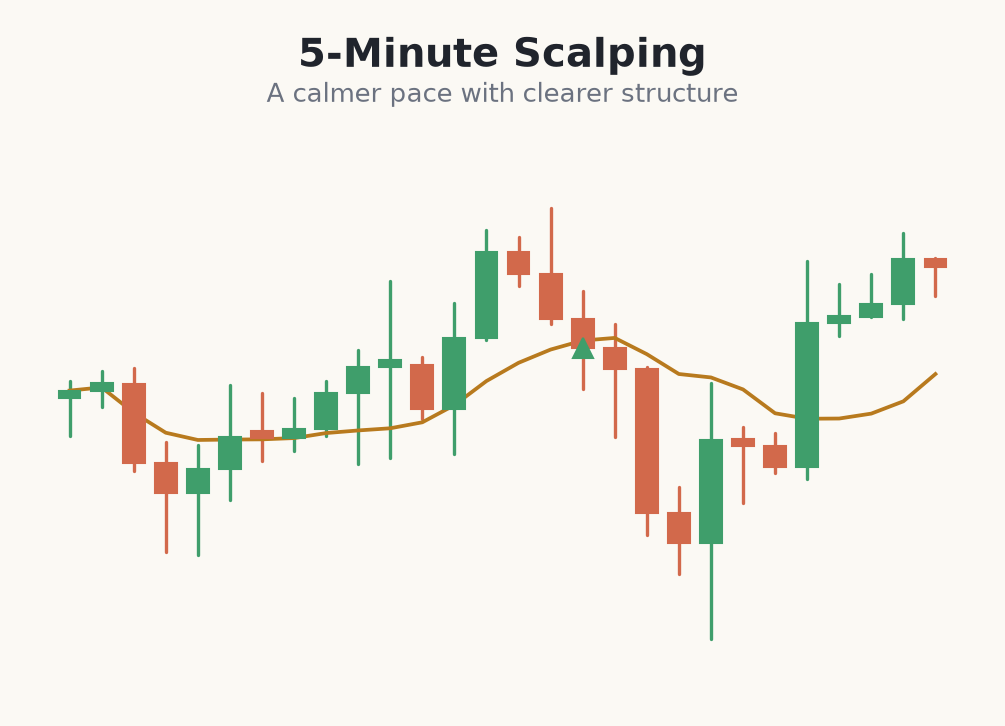
Using a moving average
A single moving average — say a 20 or 50 period — can act as a simple trend filter. When price holds above a rising average you favour longs; below a falling average you favour shorts. The average is not magic; it just summarises recent price so you avoid fighting the immediate direction.
A pullback-to-average scalp
A common 5-minute approach waits for price to pull back to the average in a trend, then looks for a candle showing the trend resuming. The stop sits beyond the pullback's swing, and the target is a nearby level or a fixed reward multiple. It works because you are buying a dip in an uptrend, not chasing an extended move.
- Trend filter: price above a rising MA → look for longs; below a falling MA → shorts.
- Entry: a pullback into the average that shows the trend resuming.
- Stop: beyond the pullback swing, sized to a fixed small risk.
- Remember a moving average lags — it confirms, it does not predict.
A 5-minute pullback-to-MA scalp on a €1,000 account
- 1On the 5-minute GBP/USD chart price is trending up and holding above a rising 20-period MA. Bias is long — you wait for a dip.
- 2Price pulls back to the average near 1.27000 and prints a bullish close showing the trend resuming. You enter long at 1.27020.
- 3Stop goes just below the pullback swing at 1.26960 — a 6-pip risk. A close there breaks the structure and the MA no longer supports the trade.
- 4Risk 1% = €10 on 6 pips means ~0.16 lots (about €1.60 per pip). The 5-minute stop is wider than a 1-minute one, so the position is smaller — risk in euros stays fixed.
- 5Target the prior 5-minute swing high at 1.27140, ~12 pips away — a clean 2:1: €20 potential versus €10 risk.
- 6Because the target is 12 pips, a 1-pip spread is a smaller fraction than on a 1-minute scalp — one reason the 5-minute is friendlier: cost drag is lighter per trade.
Common mistakes on the 5-minute chart
- Treating the moving average as a signal by itself. A touch of the MA is not an entry. You still need a candle showing the trend actually resuming.
- Fighting the MA slope. Buying dips while the average is falling is countertrend guessing. Only take longs above a rising MA, shorts below a falling one.
- Forcing 1-minute pace onto the 5-minute. Setups form more slowly here. Clicking every candle because 'nothing is happening' throws away the chart's main advantage.
- Chasing the pullback that never comes. If price runs without pulling back to the average, let it go. Entering extended means a wider stop and worse reward.
- Ignoring that the MA lags. In a sudden reversal the average is still pointing the old way. Structure and levels override a smoothed line every time.
The 5-minute chart trades a little slower and cleaner than the 1-minute — for most people that is a feature, not a compromise.