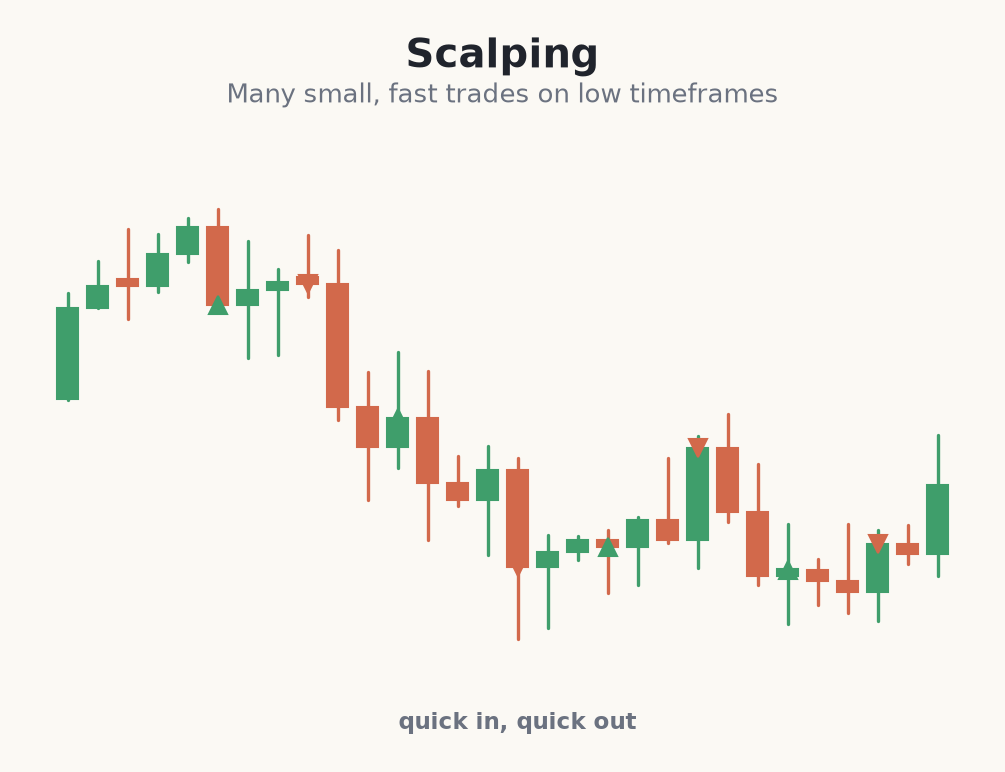
Scalping is a style of trading that takes many small, quick trades on the lower timeframes, aiming to capture a handful of pips or points at a time. Intraday trading is the broader idea of opening and closing positions within the same day so you carry no overnight risk. Both live on the fast end of the market, where a trade can open and close inside a few minutes and where your reaction time matters as much as your analysis.
Why scalping is the hardest style
Beginners are often drawn to scalping because it looks exciting, but it is the hardest style to do well. Decisions come in seconds, mistakes compound quickly, and there is little time to think. Most traders are better served learning higher-timeframe trading first, where the pace is forgiving and the lessons are the same.
The uncomfortable truth is that costs matter enormously when your target is small. Every trade pays the spread and often a commission, so if you aim for five pips and the spread is one pip, you are already giving away a fifth of the move before price does anything. Scalping only works on low-cost instruments and with a broker whose execution you trust.
- Scalping = many small trades on 1-minute and 5-minute charts.
- Intraday = flat by the end of the day, no overnight exposure.
- Spread and commission eat directly into every small target.
- Discipline and focus matter more here than in any other style.
How costs eat a small scalp — the maths on a €1,000 account
- 1Your account is €1,000 and you risk 1% = €10 per trade. You scalp EUR/USD on the 1-minute chart with a spread of 0.8 pips plus commission.
- 2You spot a micro-pullback and go long at 1.08500, stop just below the swing at 1.08450 — a 5-pip risk. To lose only €10 on 5 pips you size ~0.20 lots (€2 per pip).
- 3Your target is the next micro-level at 1.08600, ~10 pips away — a clean 2:1 reward on paper, €20 win versus €10 loss.
- 4Now count the cost. At 0.20 lots the 0.8-pip spread costs ~€1.60 and commission adds ~€1.00 round-turn. That ~€2.60 tax is over a quarter of your €10 risk, taken on every single trade.
- 5So your real win is closer to €17 and your real loss closer to €12.60. Take 20 such trades a day and costs alone drain ~€50 — a real 5% of the account — before your edge even shows up.
- 6The lesson: on tiny targets, cost is not a rounding error. It is the main thing standing between a positive edge and a slow bleed.
Common beginner mistakes when starting to scalp
- Choosing scalping first because it looks exciting. It is the least forgiving style. Learn on higher timeframes where a mistake costs you minutes of thinking, not seconds.
- Ignoring the spread on a small target. A 1-pip spread on a 5-pip target gives away 20% before you start. If you cannot say your cost per trade in euros, you are not ready to scalp.
- Overtrading to feel productive. Every extra low-quality click adds cost and risk without adding edge. Ten forced trades usually beat you slower than one big loss.
- Trading a wide-spread or illiquid instrument. Exotics and thin CFDs can trend beautifully yet leave nothing after cost. Scalp only where the spread is genuinely tight.
- Expecting a signal to save you. No setup wins every time. Discipline and fixed risk keep a losing streak survivable — nothing else does.
Scalping is the fastest, hardest style — it rewards discipline and low costs, and punishes impatience and overtrading.
This course builds the pieces in order: timeframes, then the instruments and sessions that suit fast trading, then a set of intraday setups, and finally risk and a written plan. Nothing here is a signal or a promise — no setup wins every time, and risk management is what keeps a bad run survivable.