Everything in this course — structure, levels, breakouts, pullbacks, fakeouts, ranges, reversals, timeframes — is scattered knowledge until you connect it into one process. A trading plan is that process written down: a fixed set of rules telling you what to trade, when to enter, where to exit, and how much to risk. Its whole job is to remove improvisation at the exact moment your money is on the line and your judgement is worst — when price is moving fast and your pulse is up.
Beginners lose not because they lack setups but because they trade differently every time: bigger size after a loss, no stop when it 'looks obvious', chasing an entry that already ran. A written plan converts trading from a series of one-off gut decisions into a repeatable experiment you can measure and improve. This final module is the recap that ties the whole course together into that plan.
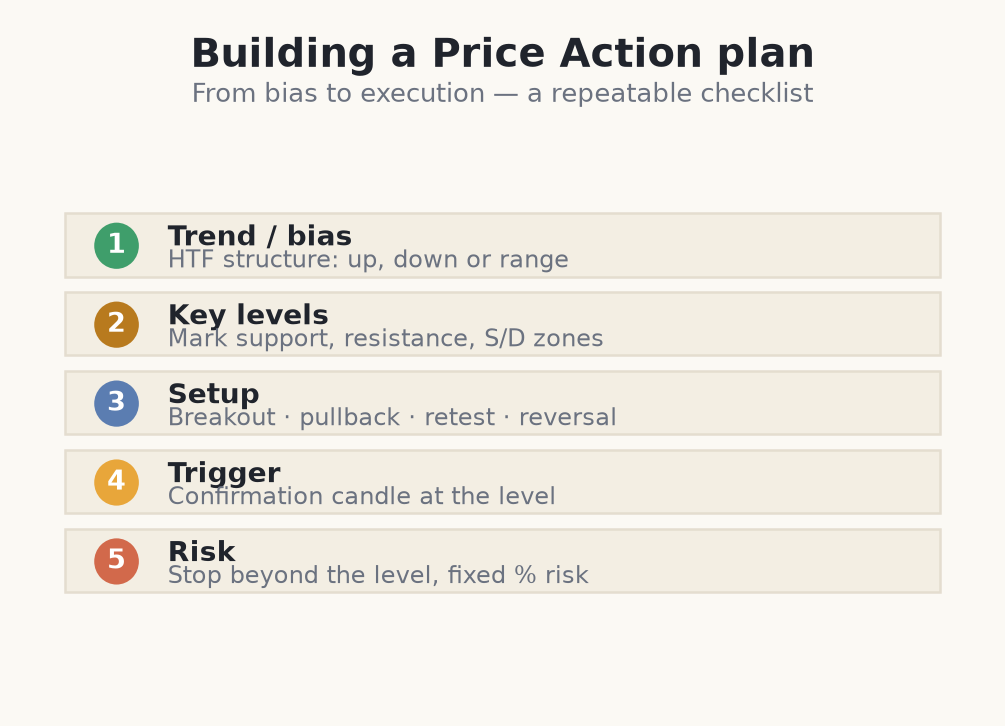
The five-step checklist
Run every potential trade through the same five questions, in order. If any step fails, there is no trade — you do not skip ahead. This is deliberately boring: the consistency is the edge, not the cleverness.
- <strong>Bias</strong> — what is the higher-timeframe structure? Up, down, or range? This decides whether you are hunting buys, sells, or standing aside.
- <strong>Level</strong> — is price at a meaningful level, supply/demand zone, or structural swing point? No level, no trade.
- <strong>Setup</strong> — does a defined setup you know appear here (breakout, pullback, retest, range edge, confirmed reversal)?
- <strong>Trigger</strong> — is there a real confirmation to enter, such as a candle close or a rejection wick, rather than a hope that it 'should' turn?
- <strong>Risk</strong> — where exactly is the stop, where is the target, and does the reward justify the risk (aim for at least 1.5–2R)?
Sizing from the stop, not the other way around
The single rule that keeps beginners alive is to risk a small fixed percentage of the account per trade — commonly 1%. You never decide 'how many lots feels right'. You decide your stop from the chart, then let that distance dictate the size so that being wrong always costs the same small amount. Position size is an output of your stop, never an input.
Running the checklist on one live trade
- 1Bias: On the 4-hour, GBP/USD prints higher highs and higher lows — a clean uptrend. You only look for buys.
- 2Level: Price pulls back to a prior swing high that flipped to support at 1.2700 — a meaningful structural level, not mid-air.
- 3Setup: This is a pullback-to-support in an uptrend, a setup you know and trust.
- 4Trigger: On the 15-minute you get a bullish rejection candle that closes back above 1.2700. You enter at 1.2710.
- 5Risk: Stop goes below the pullback low at 1.2680 — a 30-pip risk. Target is the recent swing high at 1.2800, 90 pips away, so roughly 3R.
- 6Sizing: account €5,000, risk 1% = €50. A 30-pip stop means you size so 30 pips costs €50 — about 0.16 lots. If 1.2680 breaks you lose €50 and no more; if 1.2800 hits you make roughly €150.
Notice that not one decision in that trade was improvised. The bias, the level, the setup, the trigger, the stop and the size were all decided by rules before a single euro was committed. That is what a plan buys you: freedom from having to be brilliant in the moment.
Making the plan stick
A plan you don't follow is worthless. Keep a trading journal of every trade — a screenshot, the setup name, the outcome, and one honest line: did I follow my rules? Over time the journal, not your memory, tells you which setups actually pay and which you should cut. Progress comes from refining one clear process across many trades, not from swapping strategy every week because the last three lost.
Common mistakes with trading plans
- Not writing it down. A plan 'in your head' bends under pressure. If it isn't written, it isn't a plan — it's a mood.
- Sizing by feeling. Picking lot size before knowing the stop, or going bigger to 'win it back', is how accounts blow up in a single afternoon. Fixed percent, sized from the stop, every time.
- Skipping checklist steps. Taking a trade with a great setup but no clear invalidation, or entering with no trigger because you're impatient, breaks the whole process.
- Overcomplicating it. A five-line plan you follow beats a twenty-page plan you ignore. Start simple and only add rules the journal proves you need.
- Judging the plan on one trade. Any good plan loses regularly. You measure it over dozens of trades, not by whether the last one worked.
Finally, stay honest about the limits. No setup wins every time, drawdowns are normal, and consistency comes from discipline, patience and protecting capital — not from predicting the future. The market owes you nothing; the plan just makes sure that when you're wrong it's cheap, and when you're right it counts.
A written plan plus strict, stop-based risk management beats any single setup. Run every trade through the same checklist and size from your stop — the repeatable process is the real edge.