What it is: Everything in this course only pays off when it becomes a repeatable process. A good Fibonacci setup is not a single magic level — it is a checklist that stacks trend, confluence and confirmation, then defines the exact price where you are wrong before you ever click buy or sell.
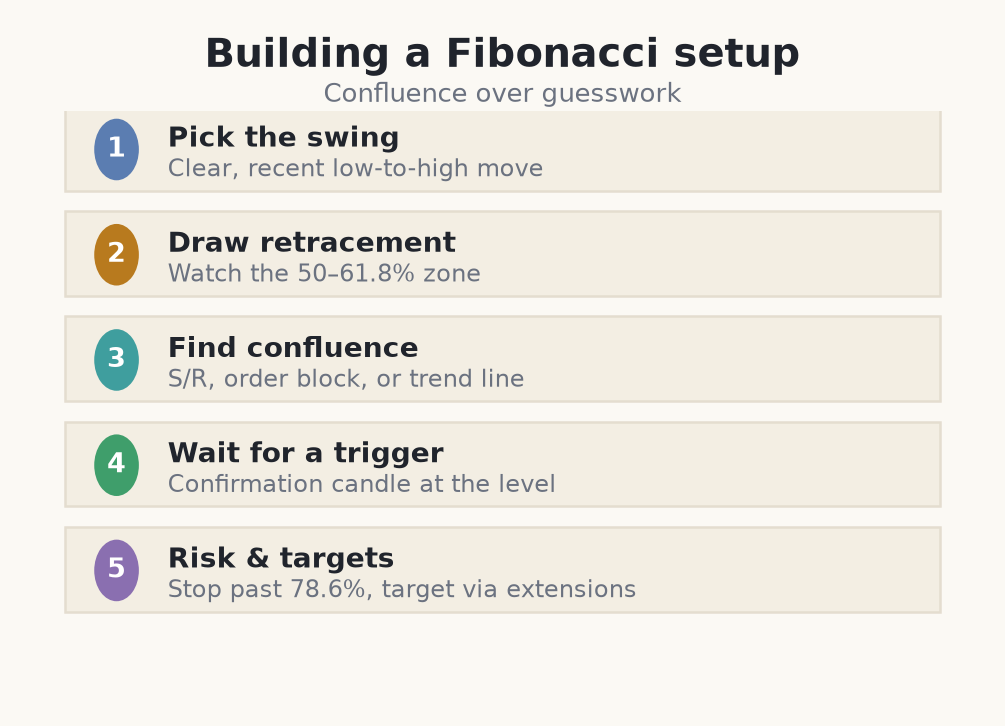
The five-step routine
- 1. Read structure — is the market trending up, down or ranging?
- 2. Draw the retracement from a clean swing in the trend direction.
- 3. Find confluence — support, an order block or a second Fibonacci level.
- 4. Wait for confirmation at the level before entering.
- 5. Set the stop beyond the level and project targets with extensions.
Notice how each step filters out weak trades. If structure is unclear, you skip it. If there is no confluence, you skip it. If confirmation never comes, you skip it. The best setups are the rare ones where every box is ticked, and discipline means being happy to do nothing the rest of the time.
Why the checklist beats a magic level
Why it works: a single Fibonacci level in isolation is roughly a coin flip. The checklist stacks independent filters — trend, confluence, confirmation — so that by the time you enter, several things agree and the low-quality trades have already been thrown out. The edge is not in any one step; it is in the discipline to only take the rare setup where all of them line up, sized so no single loss hurts.
Running the full five-step checklist — EUR/USD (€1,000)
- 1Step 1 — Structure: EUR/USD is in a clean 4-hour uptrend (higher highs, higher lows). You only look for longs.
- 2Step 2 — Retracement: draw from swing low 1.0800 to high 1.0950 (150 pips). Levels: 38.2% = 1.0893, 50% = 1.0875, 61.8% = 1.0857.
- 3Step 3 — Confluence: a tested horizontal support sits at 1.0855 and a bullish order block at 1.0850–1.0858 — both hug the 61.8%. Three factors, one zone.
- 4Step 4 — Confirmation: price dips to 1.0856 and prints a bullish engulfing. Only now do you act. Entry 1.0860.
- 5Step 5 — Risk & targets: stop below the zone at 1.0835 = 25 pips. Risk 1% of €1,000 = €10, size ≈ 0.040 lots (~€0.40/pip). Targets: 127.2% extension 1.0991 (~131 pips, ~5:1) scaling out, 161.8% 1.1043. Every box ticked — a close below 1.0835 voids it.
Common mistakes building a setup
- Skipping steps when impatient. Taking a trade with structure but no confluence, or confluence but no confirmation, defeats the whole filter. All boxes or no trade.
- Forcing setups in a range. If step 1 says 'ranging', there is no trend to trade the pullback of. Do nothing until structure is clear.
- Moving the stop to avoid being wrong. The invalidation is set in step 5 for a reason. Widening it mid-trade turns a planned 1% loss into a real one.
- Risking more than 1% because 'this one is perfect'. Perfect-looking setups still fail. Fixed risk is what keeps a losing streak survivable.
- Expecting Fibonacci to win most trades. It will not. The edge is a positive expectancy across many trades with tight risk — not a high hit-rate on any one.
A repeatable setup — structure, retracement, confluence, confirmation, defined risk — beats any single 'magic' Fibonacci level.
Finally, keep expectations honest. Fibonacci and harmonics are probabilistic tools, not guarantees, and no method offers signals that always win or a shortcut to riches. Your survival comes from risk management — fixed risk per trade, a defined stop, and a written plan you actually follow.