The tools only become an edge when combined into a repeatable process. A volume setup layers the pieces from this course — profile levels, VWAP, confirmation and delta — into a checklist you can run the same way on every potential trade.
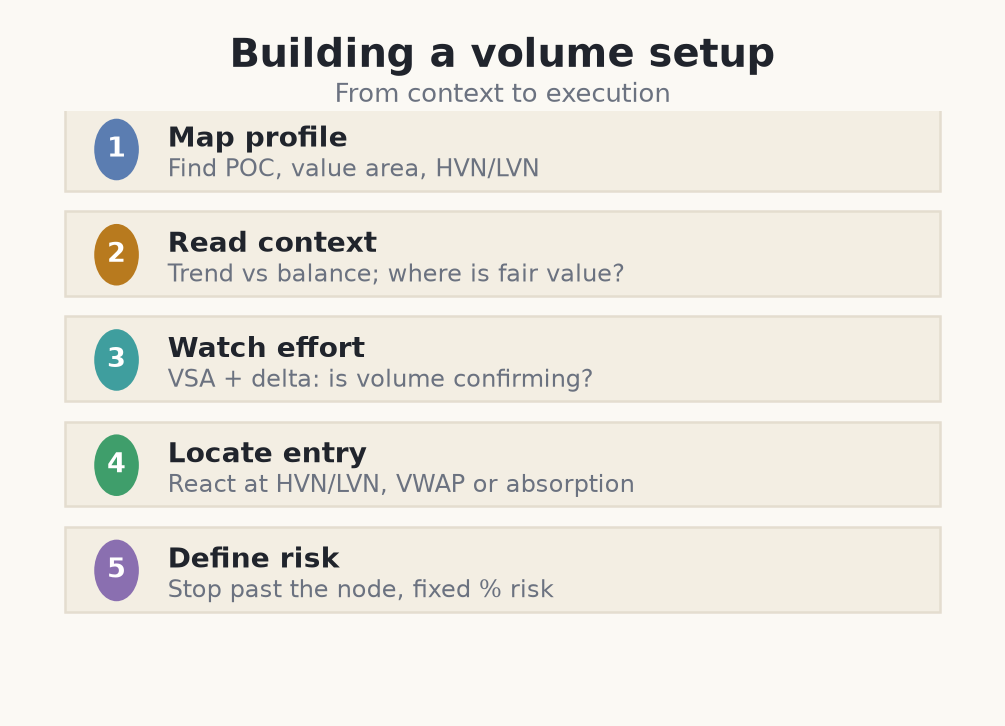
A five-step checklist
- Level: is price at a meaningful profile level — POC, value-area edge, HVN or LVN?
- Bias: is price above or below VWAP, and does structure agree with the direction?
- Confirmation: does volume expand in the direction you expect on the trigger?
- Flow: does delta or cumulative delta support the move rather than diverge from it?
- Risk: where is the stop beyond the level, what is the target, and is the reward worth it?
A concrete example: price pulls back to a rising VWAP that sits on an HVN, buyers return on expanding volume, and delta turns positive. You enter on confirmation with a stop below the node and target the next high volume area — a plan where every part is defined in advance.
Risk management keeps you in the game. Risk a small fixed percentage of your account per trade and size the position from your stop distance, never the other way around. A volume edge means nothing if one bad trade does lasting damage.
Making it stick
Keep a trading journal with the setup, a screenshot of the volume picture, and the outcome, then review it to refine one clear process over many trades. Remember the honest limits — CFD volume is a tick proxy, no tool wins every time, and volume is context, not certainty. Trade the plan, not the emotion.
Running the full five-step checklist (€1000 account)
- 1Level: EUR/USD pulls back to 1.0855, an HVN that also sits on the value-area low.
- 2Bias: price is above a rising VWAP at 1.0851 and structure shows higher lows — longs favoured.
- 3Confirmation: the pullback stalls and a bullish bar closes on expanding volume.
- 4Flow: delta flips positive and cumulative delta holds its higher low — flow agrees.
- 5Entry: long at 1.0858 on the confirmation close.
- 6Stop: 1.0843, below the HVN and VWAP where the thesis fails — a 15-pip risk.
- 7Risk 1% of €1000 = €10. At €1 per pip, size ≈ 0.66 mini-lots (€10 / 15 pips).
- 8Target: next HVN / value-area high at 1.0903 = 45 pips, roughly 3R; only take the trade if all five boxes tick.
Setup mistakes that cost money
- Taking the trade with only three of five boxes ticked because you are impatient — a checklist you skip is not a checklist.
- Sizing the position first and forcing the stop to fit, instead of sizing from a fixed 1% risk and the stop distance.
- Adding more indicators after a loss rather than reviewing the journal to see what actually failed.
- Moving the stop wider mid-trade to avoid being wrong — that turns a planned 1% loss into a 3% one.
- Believing the setup should win every time; even a good process has losing streaks, and over-leverage is what ends accounts.
A written volume checklist plus strict risk management beats any single indicator — process, not prediction, is the real edge.