Stock indices such as NAS100 (the Nasdaq 100) and US30 (the Dow) are prized by scalpers for their strong momentum, particularly around the US cash-market open. When the equity session begins, volume surges and moves can be fast and directional.
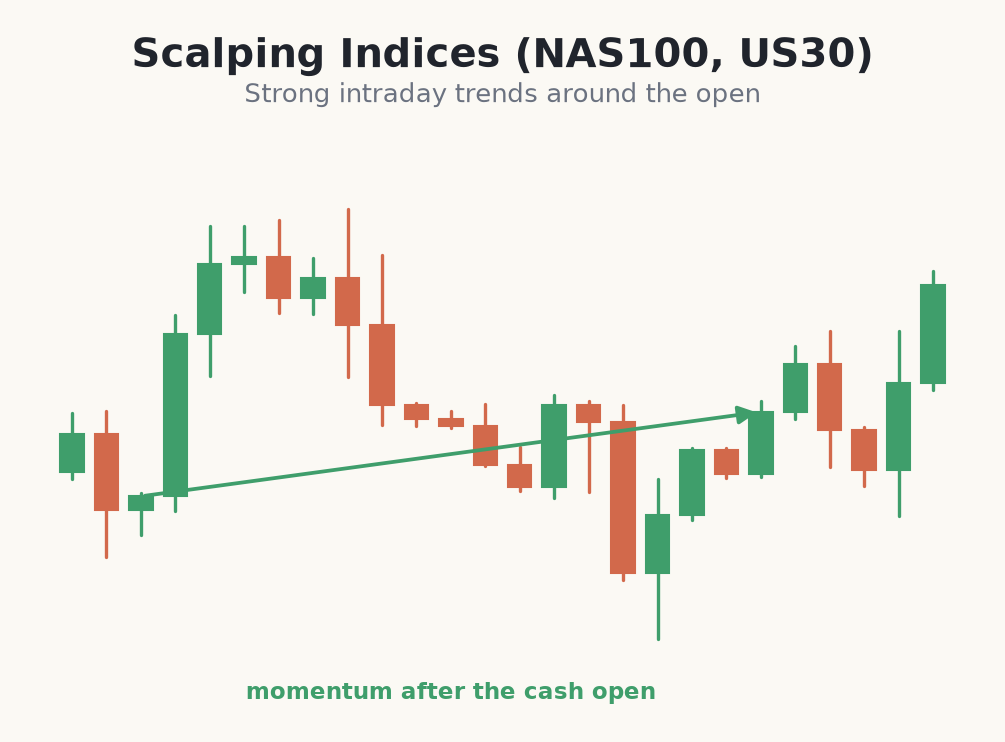
The energy of the open
Around the open, the day's news and overnight positioning are digested at once, producing a momentum burst. Scalpers try to ride the initial thrust or trade the first clean pullback. But the same energy that creates opportunity also creates violent two-way whipsaws that can stop you out in both directions.
Respecting index risk
Indices move in points, and a single point can be worth a meaningful amount, so position sizing deserves extra care. It is easy to underestimate how quickly a fast index can travel against a trade. Keep size modest, keep the stop at a logical level, and let the fixed-risk rule decide how many contracts or lots you carry.
- Momentum concentrates around the cash open and major news.
- The first thrust and first pullback are common scalping targets.
- Whipsaws are frequent — the open cuts both ways.
- Size for the point value, not the price — risk stays fixed.
A NAS100 open-momentum scalp on a €1,000 account
- 1The US cash open fires and NAS100 thrusts up. Price makes a first pullback to a micro-level at 18,000 and holds. You enter long at 18,004.
- 2Your stop sits below the pullback low at 17,984 — a 20-point risk. Indices move in points, and 20 points is a realistic swing on this fast instrument.
- 3Say your broker's NAS100 is worth about €0.10 per point per 0.1 lot. Risk 1% = €10 on a 20-point stop means you carry roughly 0.05 lots so a hit costs ~€10.
- 4Target the prior high near 18,044, ~40 points away — a 2:1: €20 potential versus €10 risk.
- 5The catch is speed: the open can whipsaw both edges, spiking through 17,984 and reversing in seconds. That is why size stays modest and the stop stays at a logical level, never widened.
- 6Because a single point carries real money, you size for the point value, not the big index number — the €10 risk is what decides your lots.
Common mistakes scalping indices
- Sizing off the price, not the point value. An 18,000 number looks huge, but risk is set by points × value. Ignore the headline figure and size to your €10.
- Chasing the opening thrust. Jumping in after the first spike means a worse fill and a wider stop. Wait for the first pullback to hold.
- Underestimating whipsaws. The open routinely stops out both longs and shorts within minutes. A stop too tight for the noise gets shredded.
- Trading full size right at the bell. The most violent moves come in the first minutes. Smaller size there, or a few minutes' patience, saves accounts.
- Holding a scalp into a sudden reversal. Index momentum flips fast. If the level fails, take the small planned loss instead of hoping.
Indices offer momentum energy at the open — treat that energy as risk to be sized down, not as free money.